
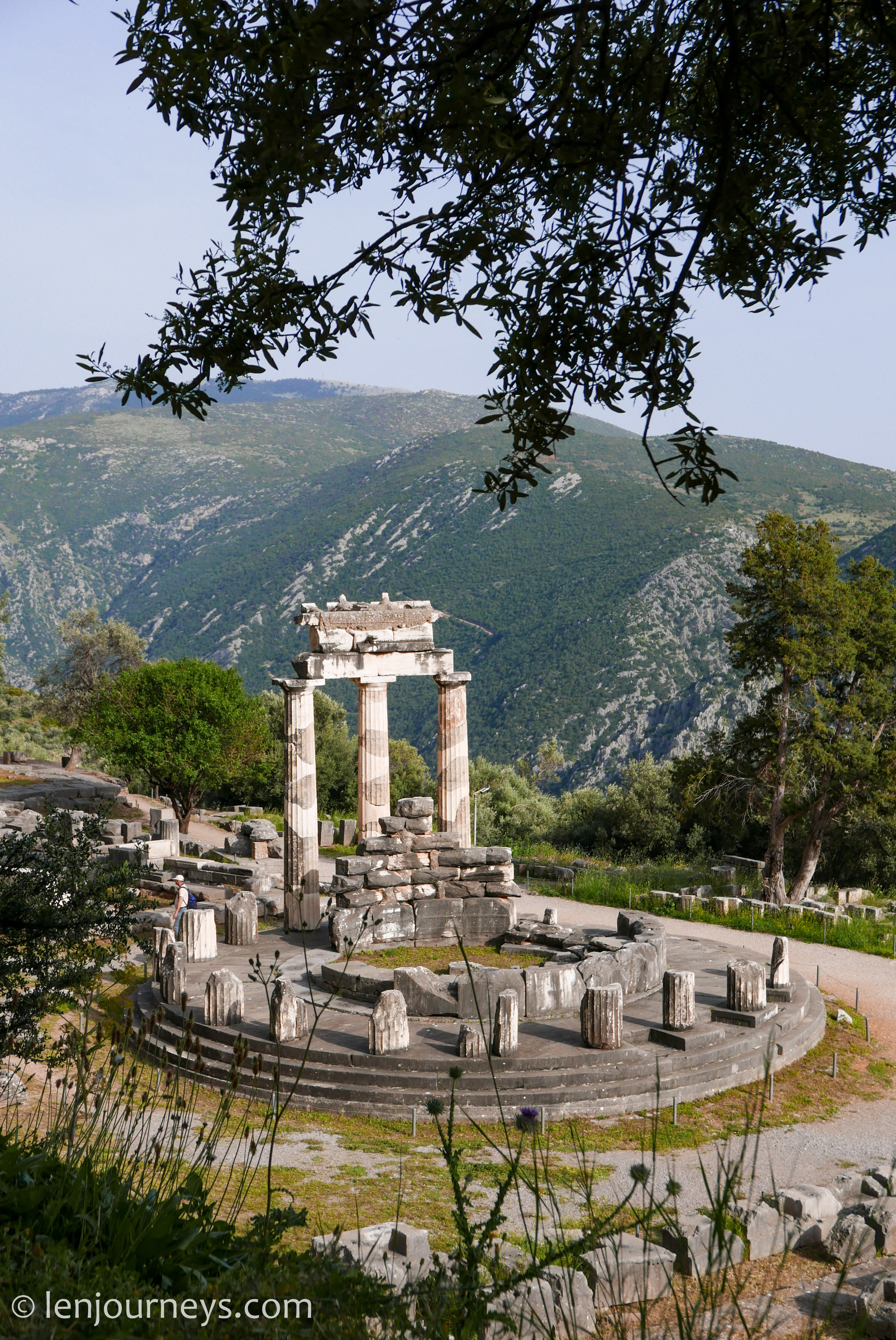
Set high on the slopes of Mount Parnassus, with spectacular views over olive-tree-covered valleys and out to the sea, Delphi was known to the ancient Greeks as the center of the world. They came here to seek prophecies and judgments from the almighty Apollo – who delivered them through the words of mystical priestesses called Pythia, better known as the Oracle.
According to Greek mythology, Zeus – the God King – sent two great eagles flying from the eastern and western extremities of the Earth to search for its center. After days and nights, the eagles crossed paths at one spot among the magnificent peaks of Mount Parnassus, which later became Delphi. Zeus marked it with a stone called the omphalos, or navel of the world – and it still exists there today. Historical records, however, indicate that this site in central Greece was settled as early as the Neolithic Age, with extensive occupation beginning in the Mycenaean period, from 1600 to 1100 BC. The town only gained relevance across Greece in the 7th century BC as the sacred precinct of the Oracle – the high priestess who channeled prophecies from Apollo, the Sun God.
As words of the divinity, the prophecies were considered the absolute truth. Hence, the Oracle of Delphi became a highly revered figure, with whom kings and warlords throughout ancient Greece often consulted before making important decisions. Her influence extended even beyond the Greek world, reaching as far as Lydia (modern Türkiye) and Egypt. Indeed, it would be impossible to remove the significance of this mystical Delphic priestess from the written history of the times, where the word “oracle” has been passed down in all languages as a byword for prophecy.
By the early Roman Empire, Delphi remained an important religious site despite being pillaged and damaged a couple of times. The town was even granted autonomy under Emperor Hadrian, who greatly admired Greek civilization. Yet things started to go south with the rise of Christianity in the late 4th century. Pagan practice was outlawed, and temples, including those in Delphi, were closed down. And with more and more predictions that did not come true, the oracle’s credibility waned. As its sanctity was stripped away, Delphi fell into oblivion for over a millennium until a French excavation team rediscovered it in the late 19th century. The temple complex once again saw the light of day, with many of its glorious monuments being uncovered and restored.
The Oracle of Delphi delivered the divine messages from Apollo.



1. Temple of Apollo
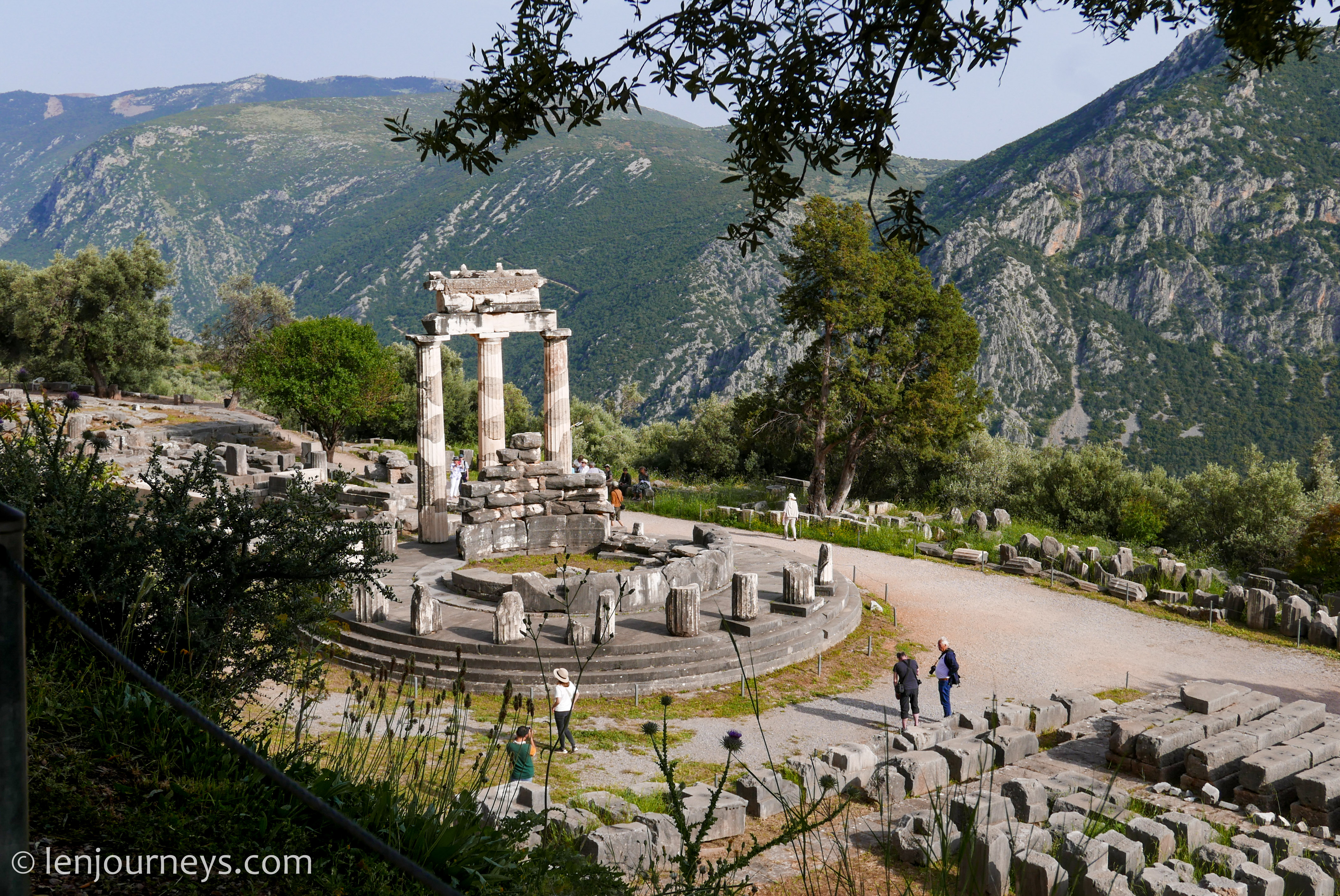
Surrounded by staggeringly beautiful nature, the sanctuary of Delphi, or more specifically its ruins, speaks to the place’s ancient history. This UNESCO-inscribed site sprawls over a rocky mountain slope and includes a series of buildings and structures, such as temples, treasuries, an amphitheatre, and a stadium. Most of the surviving monuments date to the sanctuary’s most active period in the 6th century BC and were donated and constructed by pilgrims.
Delphi Sanctuary’s most sacred structure.
The most prominent is the Temple of Apollo, situated on the third terrace, because at this very spot, the Oracle shared Apollo’s prophecies. She did so in a trance, intoxicated by the hallucinogenic vapors. In this state, she allowed Apollo to possess her body and began prophesying from the inner sanctum sunken beneath the temple’s floor. When asked a question, the Oracle never gave a direct answer. Instead, she spoke in ambiguities or allegories with hidden, deeper meanings. It was then up to the inquiring party to interpret them.
Following a fire and a strong earthquake, the original temple was devastated, with its entire roof collapsing. All that remains today are six broken honey-colored Doric columns and an elevated stone foundation – all from the structure rebuilt in 330 BC.
Good to Know: The Temple of Apollo plays a crucial role in Greek mythology, as it’s here that Deucalion and Pyrrha landed after the Great Flood. They were also responsible for repopulating Earth by throwing stones over their shoulders. In other words, they are like the Greek version of Adam and Eve, as well as Noah’s Ark. The temple is also considered the starting point of Hercules’s legendary twelve labours, where the mighty warrior received the first guidance from the divinity through the voice of the Oracle.


2. Athenian Treasury
Below the temple stands a series of so-called treasuries which were built by different – and often rival – Greek city-states to honor their military or economic successes thanks to the Oracle’s prophecies. Each piece served as a lasting demonstration of the city’s wealth and glory, holding votive objects to Apollo, as well as a tenth of the battle spoils. This practice led to an astonishing accumulation of monuments and sculptures at Delphi. It also reflected a pan-Hellenic harmony at this “center of the world”.
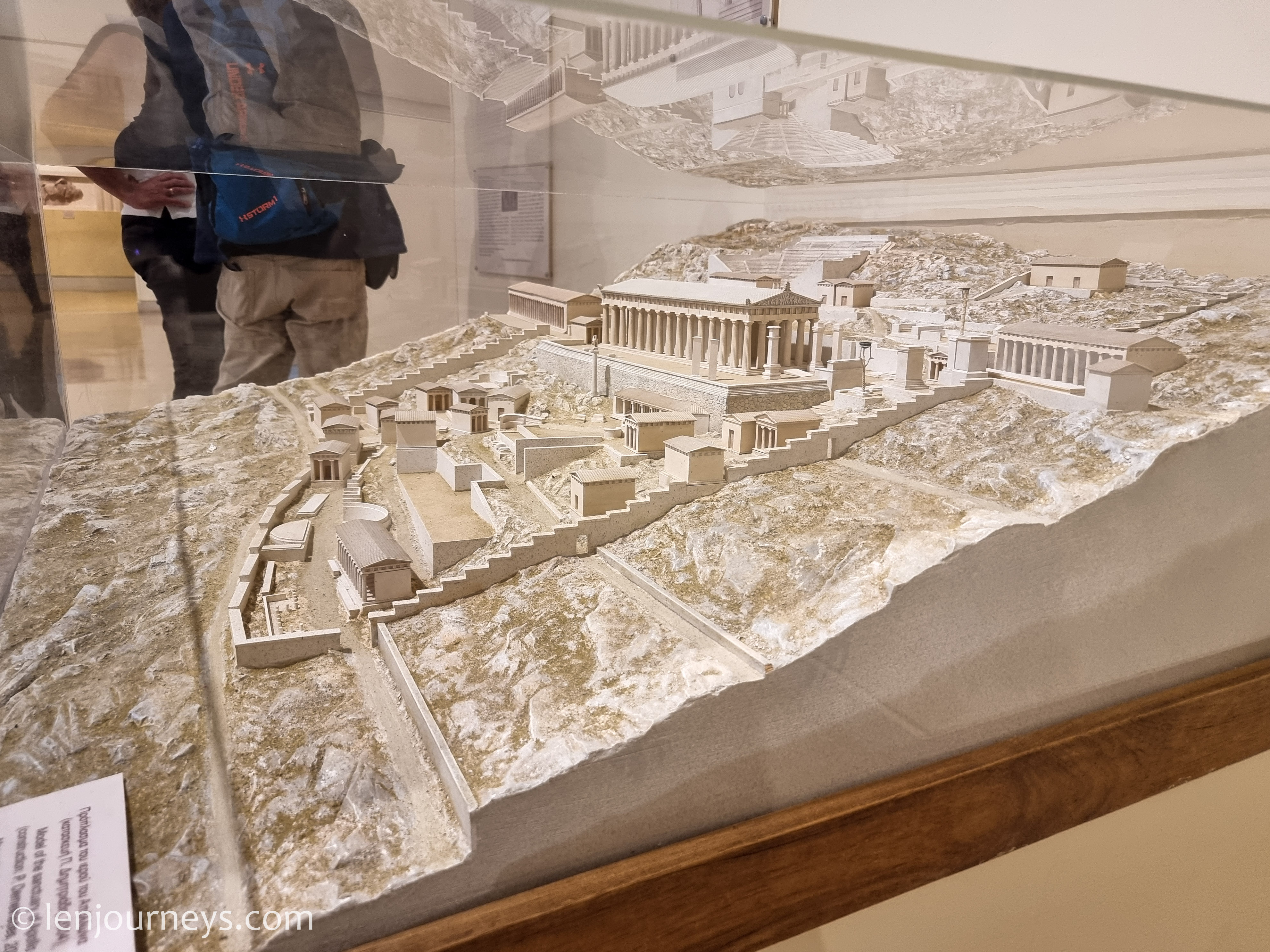
Though most of these treasuries are now in tatters, we can still visualize how impressive they were through the restored Athenian Treasury, constructed in 490 BC to commemorate Athens’ victory against the Persian Empire at the Battle of Marathon. Made out of white marble, the building resembles a small temple, featuring sturdy Doric columns, a gable roof, and ornate friezes. The walls of the Treasury are literally covered with tiny carved inscriptions, recording a hymn to Apollo and the ritual processions.


3. Amphitheater & Stadium
Overlooking the Temple of Apollo is an amphitheater that dates back to the 4th century BC. It leans against the natural form of the slopes and contains 35 rows that could seat 4,500 spectators. In antiquity, the theater served as a venue for poetry and music contests at the pan-Hellenic Pythian Games, taking place every four years. The festival was ranked second only after the Ancient Olympic Games and held in honor of Apollo and the Oracle.
Meanwhile, the athletic competitions were hosted further up the hill in an oval stadium with a capacity of nearly 6,500 spectators. It was originally built in the 5th century BC and features a running track measuring 177 meters long and 25.5 meters wide. Over time, both the amphitheater and the stadium underwent several transformations, yet their main components were largely intact, including the layout and the limestone seats.
Good to Know: The Oracle has another name, Pythia. It originates from Python, a great serpent and a son of Earth. He occupied Delphi until Apollo slew him and took over the site. Therefore, in honor of this mythical creature, the Oracle was called Pythia.


4. Tholos of Delphi
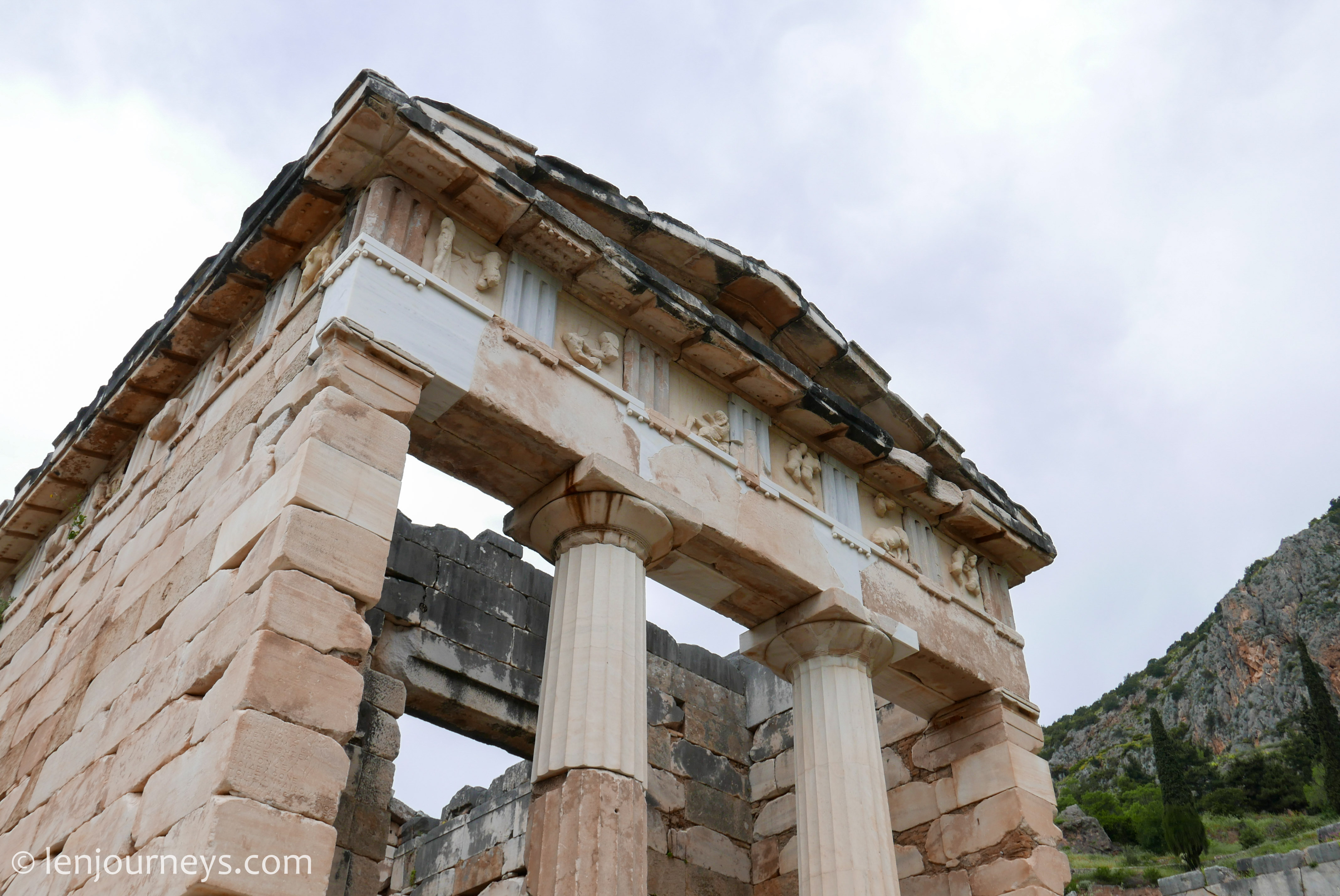
Less than one kilometer from the temple complex stands an elegant circular structure that has become an icon of Delphi, the Tholos. Dating to around 380 BC, it originally consisted of two concentric rings of marble columns, with 20 Doric columns on the exterior and 10 Corinthian columns in the interior. Today, three restored columns and part of the entablature stand upright, while fragments of the structure are neatly arranged around them.
Unlike the previously mentioned buildings, the tholos was dedicated to neither the Oracle nor Apollo. Instead, it was presumably used to worship Athena, the Goddess of Wisdom and a sister of Apollo. The structure shares the immediate site with a series of ancient temples, treasuries (at least two), and an impressive gymnasium completed with a pool and baths for the youth of Delphi at the time.


5. Delphi Archaeological Museum
Nearby, the Archaeological Museum showcases Delphi’s history through thousands of priceless discoveries. It’s the third museum on this site, which opened its doors to the public on its centennial anniversary in 2003. Here, votive objects, inscriptions, architectural elements, and numerous sculptures are displayed across fourteen exhibition halls on two floors. Highlights include intricate bronze cauldron handles, griffon-shaped golden ornaments, the elaborate caryatid and frieze of the Siphnian Treasury, the statue of a sphinx from Naxos, and the marble omphalos dating to the 4th century BC.
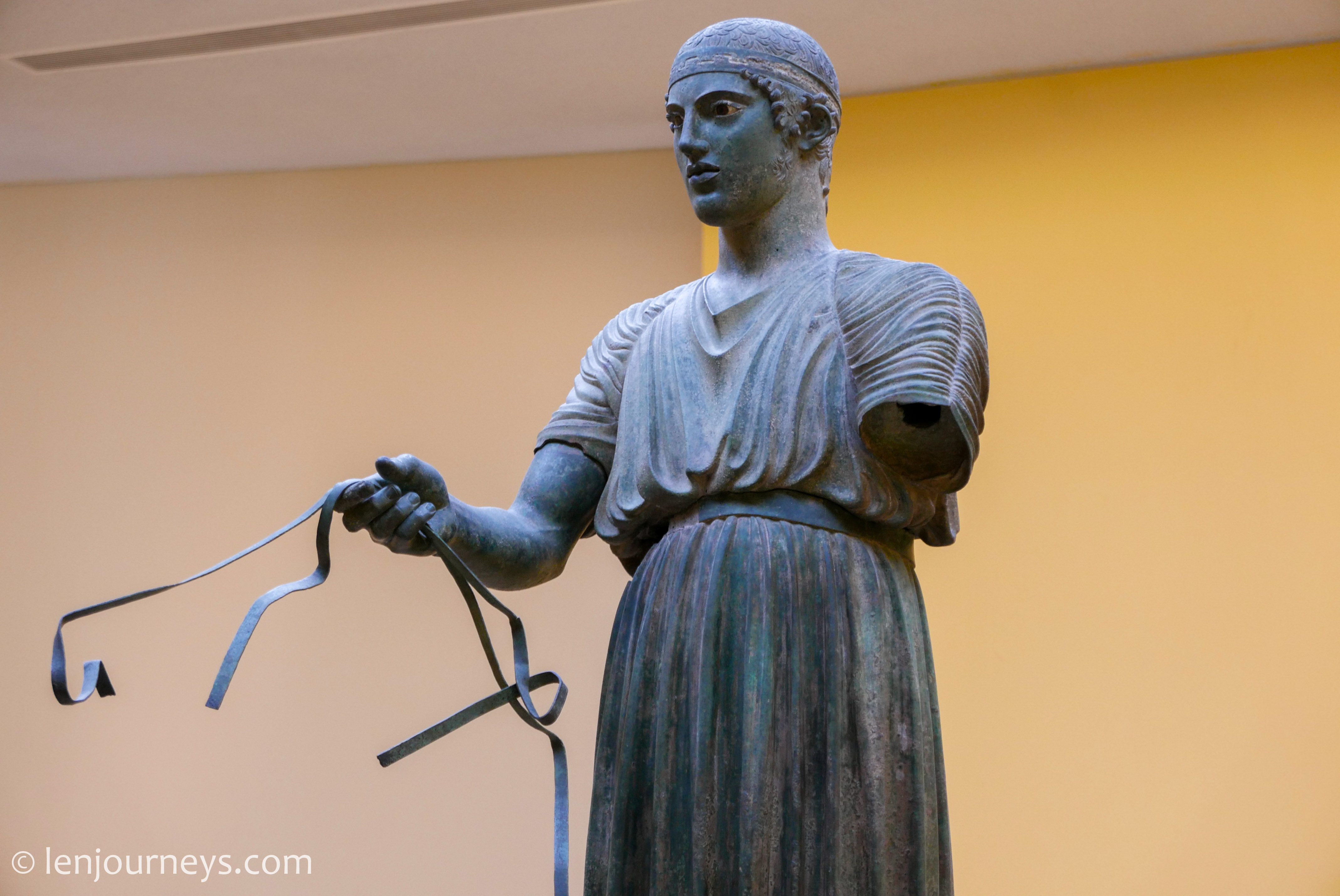
Yet the most striking exhibit is undoubtedly the Charioteer of Delphi. Unearthed in 1896, this exquisite bronze statue was the first monumental discovery during the excavations at the Temple of Apollo. The young athlete stands about 1.8 meters tall, with his right hand holding the reins. He wears a headband and a long tunic with richly and evenly spread-out drapery. Inscriptions at the base indicate that the Charioteer was erected in the 470s BC to celebrate a victory in racing at the Pythian Games. Although missing many features, including its chariot and left hand, the sculpture is still an incredible example of sporting art in antiquity.


Tips for Visiting Delphi
- About 180 km northwest of Athens, Delphi is easily accessible by car. The scenic drive usually takes about two and a half hours, passing through Greece’s beautiful countryside.
- KTEL bus is a good alternative. It takes around three hours and costs between €16 and €18 one way. The bus departs from Terminal B (Liosion) and drops off near the archaeological site’s main entrance.
- The ticket for the Archaeological Site of Delphi costs €20, and it includes admission to the museum (valid the same day).
- The Tholos is free to visit. It’s located on the main road leading to Delphi. The path is, however, quite steep.
- Delphi is doable as a day trip, but it will be very hectic. A large crowd should also be expected, as the sanctuary of Delphi is Greece’s second-most-popular archaeological site, after the Acropolis of Athens.
- For a more pleasant, crowd-free experience, it’s recommended to spend a night in Delphi town. Most buses arrive around 09:00 and leave in the early afternoon, so you can have the sites to yourself if you visit them early in the morning or late in the afternoon.
- Please note that the sanctuary of Delphi and the museum have opening hours, while the area around the Tholos is always open.
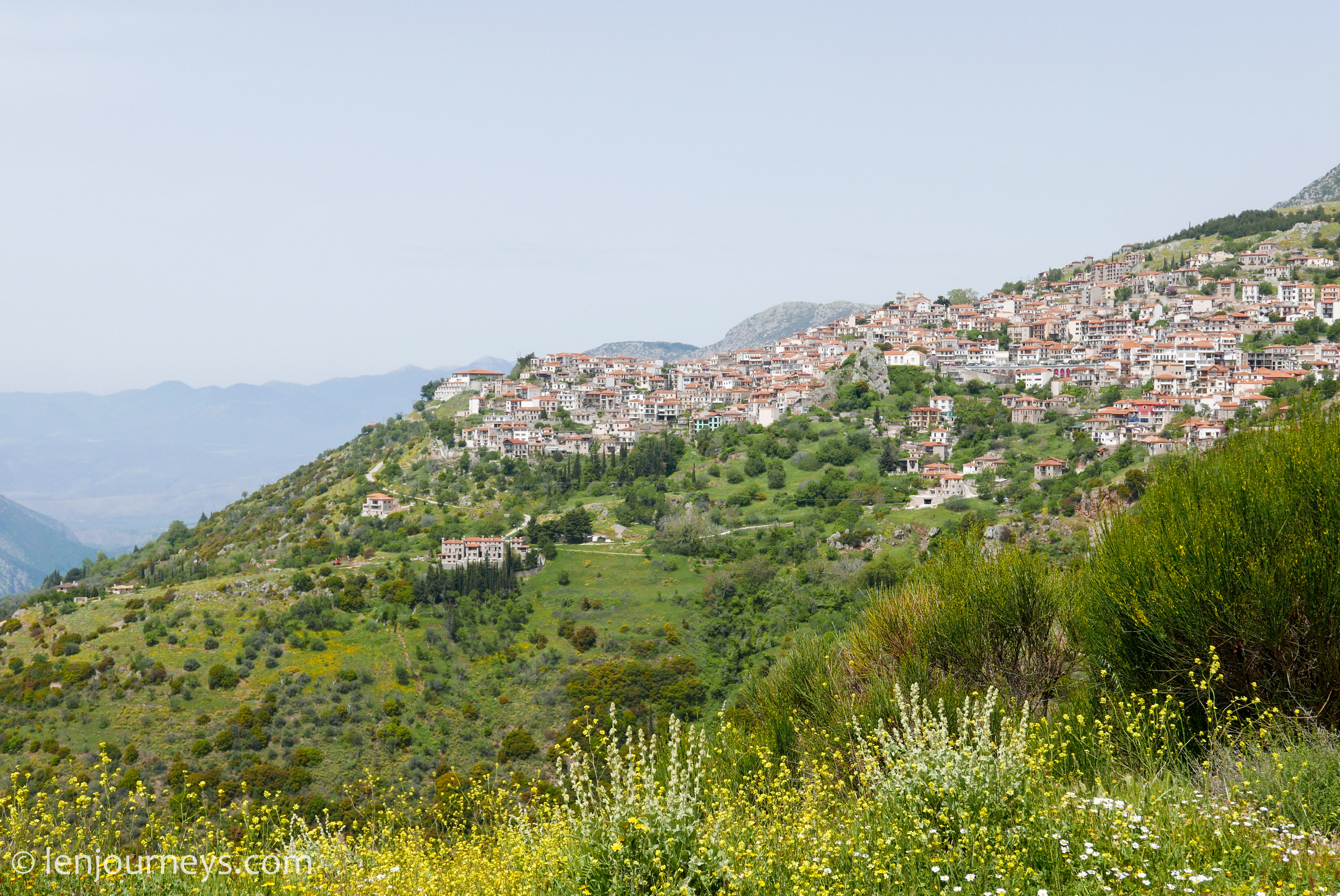
- Delphi’s modern town is lovely, with shops, retro hotels, and tavernas lining the mountain slopes. The view from the town is also breathtaking.


I remember the scene in the movie 300 where an oracle goes in trance before delivering a prophecy. Your words reminded me of that. That scale model of Delphi really helps me imagine how this site might have looked like in the past during its heyday. Otherwise, a little more imagination would be needed to picture it.
I think 300 is really helpful to understand the importance of Delphi in ancient times. No approval from the Oracle, nothing done 🙂